Yong Jae Lee
Published: April 1, 2026 · Reviewed: September 2026 · 14 min read
Researched and written by Yong Jae Lee · Content follows NZ Ministry of Health guidelines
School-safe snacks for NZ kids — morning tea ideas, nut-free options, and what each costs per serve at regular Woolworths shelf prices.
Why Snacks Matter as Much as Lunch
In New Zealand schools, children typically eat at two break times: morning tea (around 10:30am) and lunch (around 12:30-1pm). That morning tea snack is not a bonus — it is a critical part of your child's daily nutrition.
Between breakfast at 7:30am and lunch at 12:30pm, there is a five-hour gap. Without a mid-morning snack, children can experience blood sugar dips that affect concentration, mood, and learning — and a wholesome morning snack helps them stay focused through to lunchtime, especially if breakfast was light.
Yet morning tea is often where the least nutritious food ends up. A small packet of chips, a sugary muesli bar, or a fruit roll-up is quick to pack but provides a short sugar spike followed by a crash — exactly the wrong pattern for a learning environment.
It's also where the lunchbox budget quietly leaks. I re-read regular Woolworths shelf prices from their online shop every week, and the snack aisle is where the gap between two products that do the same job is widest — more than three times over, for yoghurt in a pouch rather than a tub. So this guide is in two halves: what to pack, and what it actually costs.
The Ideal School Snack: What to Aim For
A good school snack should tick most of these boxes:
- Sustaining: Contains some protein, fibre, or healthy fat to maintain energy
- Portion-appropriate: Enough to bridge the gap but not so much it replaces lunch
- Easy to eat: Can be eaten quickly and cleanly in 10-15 minutes (morning tea is short)
- School-safe: Nut-free, not overly messy, no strong odours
- Appealing to children: Because the healthiest snack in the world is useless if it comes home untouched
The Snack Formula
Pair two of these three elements for a balanced snack:
| Element | Examples |
|---|---|
| Protein | Cheese, yoghurt, hard-boiled egg, hummus, edamame |
| Fibre/Complex carbs | Whole fruit, vegetable sticks, wholegrain crackers, oats |
| Healthy fat | Avocado, seed butter, cheese, coconut yoghurt |
Example combinations:
- Cheese + wholegrain crackers (protein + fibre)
- Apple slices + sunflower seed butter (fibre + healthy fat)
- Carrot sticks + hummus (fibre + protein)
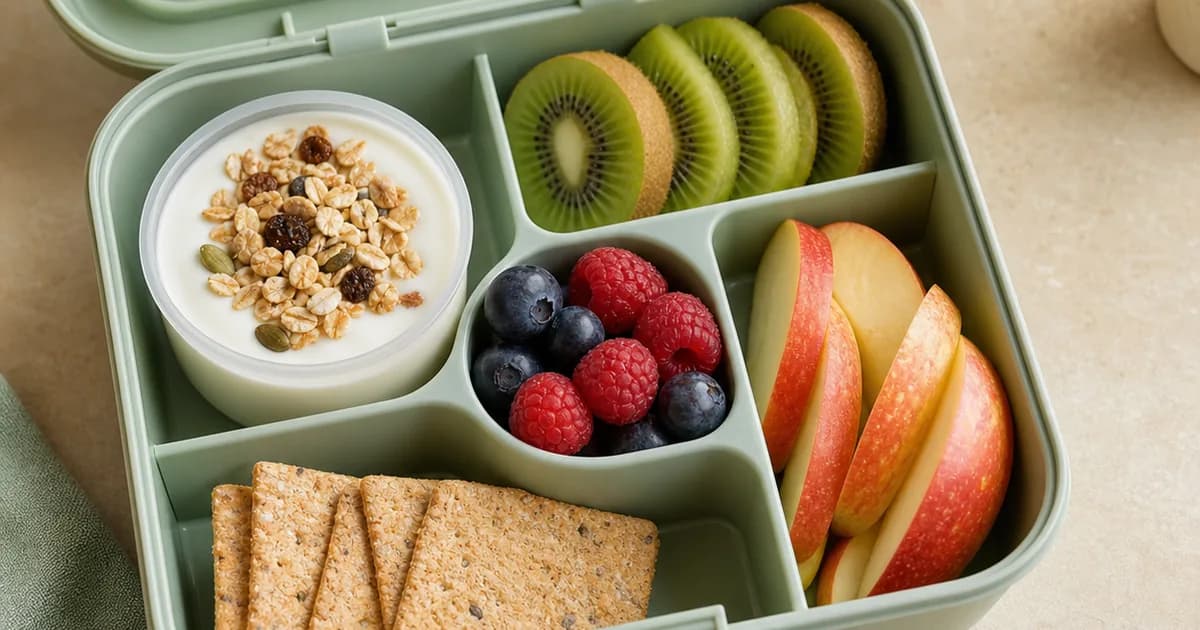
- Plain yoghurt + berries (protein + fibre)
20 Healthy Snack Ideas for NZ School Kids
Fresh Fruit (The Easiest Win)
1. Whole apple or pear — wash and send whole; kids prefer eating fruit they can hold 2. Banana — nature's perfect portable snack; cheap year-round 3. Mandarin — Easy Peel varieties are ideal for young children 4. Grapes — seedless, washed, in a small container 5. Kiwifruit — cut in half and pack a small spoon, or slice and pack in a container
Vegetable-Based Snacks
6. Carrot sticks with hummus — the classic; buy carrots whole and cut yourself to save money 7. Cucumber rounds — cool and refreshing; kids eat these readily 8. Cherry tomatoes — sweet, bite-sized, no prep 9. Capsicum strips — red and yellow are sweeter; many kids prefer these raw 10. Edamame (shelled) — frozen edamame from Woolworths, thaw overnight; excellent protein source
Protein-Rich Snacks
11. Hard-boiled egg — peel in the morning; pack with a pinch of salt 12. Cheese cubes or slices — Mainland Edam or Colby cubes are easy to portion 13. Plain yoghurt with berries — use a small screw-top container rather than a pouch; on our tracked prices every pouch costs more than twice every tub (see the cost breakdown below) 14. Cream cheese on wholegrain crackers — spread a thin layer; affordable and filling
Homemade Baking (See Recipes Below)
15. Banana oat muffins — freezer-friendly, nut-free, low sugar 16. Cheese and herb scones — savoury, filling, and cheap to make 17. Oat and coconut energy bites — no-bake, uses rolled oats, coconut, and honey 18. Vegetable fritters — grated courgette or corn; great cold 19. Homemade popcorn — air-popped with a tiny bit of butter and salt; incredibly cheap
Store-Bought (When You're Short on Time)
20. Rice crackers — plain or lightly flavoured; Sakata brand is widely available and affordable
Homemade Snack Recipes
Banana Oat Muffins (Nut-Free)
Makes 12. $6.28 the batch — 52c a muffin at this week's tracked prices.
Ingredients:
- 240g ripe bananas (about 2), mashed
- 80g melted butter (1/3 cup — or coconut oil for dairy-free)
- 90g honey or maple syrup (1/4 cup)
- 1 egg
- 5ml vanilla essence (1 tsp)
- 135g rolled oats (1.5 cups)
- 125g plain flour (1 cup)
- 5g baking powder (1 tsp)
- 3g baking soda (1/2 tsp)
- 1.5g cinnamon (1/2 tsp)
- Pinch of salt
Method:
- Preheat oven to 180°C. Line a 12-cup muffin tin.
- Mix wet ingredients (banana, butter, honey, egg, vanilla).
- Combine dry ingredients in a separate bowl.
- Fold wet into dry until just combined. Do not over-mix.
- Divide into muffin cups. Bake 18-20 minutes until golden and a skewer comes out clean.
- Cool completely. Freeze extras in zip-lock bags.
Storage: 3 days at room temperature, 3 months frozen. Take one from the freezer in the morning; it will be thawed by morning tea.
Cheese and Herb Scones (Nut-Free)
Makes 10. $3.51 the batch — 35c a scone.
Ingredients:
- 250g self-raising flour (2 cups)
- 30g cold butter, cubed
- 100g grated cheese (1 cup, Edam or Tasty)
- 2 tbsp chopped chives or parsley (optional)
- 190ml milk (3/4 cup)
- Pinch of salt
Method:
- Preheat oven to 200°C. Line a baking tray.
- Rub butter into flour until it resembles breadcrumbs.
- Stir in cheese, herbs, and salt.
- Add milk gradually, mixing with a knife until dough just comes together.
- Turn out, pat to 2cm thick, cut into rounds.
- Bake 12-15 minutes until golden.
Storage: 2 days at room temperature in an airtight container, or freeze for up to 2 months.
No-Bake Oat and Coconut Energy Bites (Nut-Free)
Makes 20. $5.12 the batch — 26c a bite.
Ingredients:
- 135g rolled oats (1.5 cups)
- 37g desiccated coconut (1/2 cup)
- 120g honey (1/3 cup)
- 30g tahini (2 tbsp)
- 28g coconut oil, melted (2 tbsp)
- 5ml vanilla essence (1 tsp)
- Mini chocolate chips (optional, not costed)
A note on the seed butter: this recipe used to say sunflower seed butter (or tahini). Woolworths does not stock a plain sunflower seed butter, so tahini is what the costing uses. Tahini is nut-free, which is the point here, but sesame is itself a declarable allergen — check your school's policy before it goes in the bag.
Method:
- Combine all ingredients in a bowl. Mix well.
- Refrigerate for 30 minutes until firm enough to handle.
- Roll into small balls (about 2cm diameter).
- Store in the fridge in an airtight container.
Storage: 1 week in the fridge, 2 months frozen.
Vegetable Fritters (Nut-Free, Freezer-Friendly)
Makes 12. $7.77 the batch — 65c a fritter.
Ingredients:
- 250g grated courgette (2 cups — squeeze out excess moisture)
- 200g corn kernels, drained (about half a 420g can)
- 2 eggs
- 60g plain flour (1/2 cup)
- 50g grated cheese (1/2 cup)
- Salt and pepper to taste
This is the one recipe here with a real season attached. Courgette is a summer vegetable, and the winter price is what makes this batch the dearest on the list — in season it drops sharply. The NZ Seasonal Produce Calendar has the months.
Method:
- Squeeze grated courgette in a clean tea towel to remove moisture.
- Mix all ingredients in a bowl.
- Heat a tablespoon of oil in a pan over medium heat.
- Drop spoonfuls of mixture into the pan. Flatten slightly.
- Cook 3 minutes each side until golden.
- Cool on a wire rack.
Storage: 3 days in the fridge, 2 months frozen. Pack cold in the lunchbox.
What a Morning Tea Snack Actually Costs
Most snack advice stops at "buy in bulk". That's true but useless without numbers, so here are ours.
The figures below are regular Woolworths shelf prices — not specials — recorded from their online shop between April and July 2026. (The NZ Lunchbox Price Index is the separate multi-chain comparison; these are not its numbers.) I've divided each pack by its serve count to get a cost per morning tea. Treat them as a dated snapshot rather than a fixed price list: they move, and they vary by store and region. The gaps between formats are wide enough that a few cents either way doesn't change the conclusion.
| Snack | Pack price (regular) | Serves | Cost per morning tea |
|---|---|---|---|
| Mother Earth Fruit Sticks 152g | $2.99 (8 pack) | 8 | 37c |
| Banana (from a snack pack) | $3.70 (6 pack) | 6 | 62c |
| Fresh'n Fruity yoghurt tubs | $4.49 (6 pack) | 6 | 75c |
| Anchor Uno / Calci Yum tubs | $9.89 (12 pack) | 12 | 82c |
| Mother Earth Baked Oaty Slice | $4.89 (6 pack) | 6 | 82c |
| Dairyworks cheese & rice crackers | $5.50 (4 pack) | 4 | $1.38 |
| Moogurt yoghurt pouch 70g | $1.99 each | 1 | $1.99 |
| Chobani no-added-sugar pouch 100g | $2.40 each | 1 | $2.40 |
The same per-serve arithmetic applied to the main part of the lunchbox is in Budget-Friendly Lunchbox Ideas Under $3 Per Meal.
The pouch tax is real, and it's bigger than you'd guess
This is the widest gap in the snack aisle. On the prices above, a yoghurt pouch costs 2.4 to 3.2 times a yoghurt tub:
- Moogurt pouch at $1.99 vs Anchor Uno tub at 82c — 2.4×
- Chobani pouch at $2.40 vs Fresh'n Fruity tub at 75c — 3.2×
Over a 40-week school year, one pouch a day instead of one tub costs roughly $230 more per child, even on the smaller of those two gaps. Those pairs are different brands, so not every cent of it is the spout — but no pouch on the list comes within twice the price of any tub.
If your child genuinely eats better from a pouch, that may be worth it to you. But it should be a decision, not a default. A reusable squeeze pouch filled from a 1kg tub (Fresh'n Fruity 1kg was $4.99 regular) works out at about 50c for a 100g serve, or roughly 35c if you fill it to the 70g a shop pouch holds — either way, a long way under $1.99.
Where the cheap options actually are
Two things surprised me when I laid the tracked data out:
Fresh fruit is not the expensive option. A banana from a snack pack is 62c and a whole apple sits around 60-70c at $3.49/kg — both cheaper per serve than every packaged snack on the list except the fruit sticks. The "fruit is dear" instinct comes from buying it by the kilo and watching some go off, not from the per-serve cost.
The cheapest packaged nut-free option is a fruit stick, not a muesli bar. At 37c, Mother Earth Fruit Sticks came in under half the price of the oaty slice I tracked. Cheap is not the same as good, though: a fruit stick is a processed fruit snack, the same family as the fruit roll-ups in the "Avoid or Limit" table below, so it is a price finding, not a recommendation. Compare its label per 100g against the alternatives before it becomes the everyday pick — and check for nuts each time, because formulations change.
Store-Bought Snacks: An Honest Guide
Sometimes you need to grab something off the shelf. Here is an honest assessment of popular NZ store-bought snacks:
These tables used to carry a price for every row. I have taken the prices out, for two reasons that are worth saying out loud. They were undated approximations that had quietly gone stale, and two of them had drifted into contradicting the dated table above — one row said "yoghurt tubs (6 pack)" beside a 12-pack price, and the flavoured-pouch row implied 81c a pouch in an article whose measured figure is $1.99 to $2.40. The prices that are actually tracked are in the table above; what belongs here is the reason.
Worth Buying
| Snack | Why It's OK |
|---|---|
| Sakata rice crackers | Low sugar, nut-free, crispy, kids love them |
| Bluebird Ready Salted chips (small) | Occasional treat; low sugar, nut-free |
| Mainland cheese slices | Good protein, easy to pack |
| Anchor yoghurt tubs | Plain or low-sugar options; good protein, and far cheaper per serve than the pouch |
| Woolworths popcorn (microwave) | Wholegrain, cheap, filling |
Avoid or Limit
| Snack | Why to Avoid |
|---|---|
| Muesli bars (most brands) | Often high in sugar for their size; many contain nuts |
| Fruit roll-ups | Mostly sugar; little fibre |
| Flavoured yoghurt pouches | Added sugar, and the dearest format in the aisle |
| Juice boxes | Free sugars with no fibre |
| LCMs / Rice Bubble bars | High sugar, minimal nutrition |
Reading the Label: Quick Sugar Check
For any packaged snack, compare the per-100g column of two products doing the same job, as our nutrition guide explains. Serve sizes are set by the manufacturer, so a per-serve cut-off mostly rewards a small serve. We have deliberately not printed a pass/fail sugar threshold.
Age-Appropriate Snack Portions
| Age Group | Snack Size | Examples |
|---|---|---|
| 5-6 years | Very small | 1/2 apple + 2 crackers, or 1 small muffin |
| 7-9 years | Small | 1 apple + small yoghurt, or 4-5 crackers + cheese |
| 10-12 years | Medium | 1 large fruit + crackers + hummus, or 2 muffins |
| 13+ years | Larger | May need two snack items plus a substantial lunch |
Tip: If your child is in year 1-2 (ages 5-6), morning tea is often short (10-15 minutes). Pack foods they can eat quickly — whole fruit, crackers, cheese cubes — rather than items that require opening, dipping, or assembling.
What Homemade Actually Costs
These are the four recipes above, costed from the grams each one lists and the pack prices I re-read at Woolworths every week. Nothing here is an estimate: change the recipe and the number changes with it.
| Recipe | Makes | Batch | Per item |
|---|---|---|---|
| Banana oat muffins | 12 | $6.28 | 52c |
| Cheese and herb scones | 10 | $3.51 | 35c |
| Oat and coconut energy bites | 20 | $5.12 | 26c |
| Vegetable fritters | 12 | $7.77 | 65c |
Two things worth saying about that table, because both cut against what this section used to claim.
The old numbers were wrong, and wrong in the flattering direction. Until August 2026 each recipe carried a line like "Cost: approximately $0.15 per muffin", and this section was a table of annual savings built on those figures. They were estimates dressed as measurements, and when the ingredients were finally costed against tracked pack prices the muffin came out at 52c — several times the published figure. The savings table on top of them went with it.
Homemade is not automatically the cheap option. Look at the packaged table further up: the cheapest tracked morning-tea item is a fruit stick at 37c, which undercuts a homemade muffin. Baking wins clearly against the dear end of the aisle — an energy bite at 26c against a Baked Oaty Slice at 82c, or a yoghurt pouch at $1.99 — and it wins on what goes into the food. It does not win against every packet on the shelf, and a guide that told you otherwise was selling you something.
A caveat on comparing the two tables: the recipe costs above are this week's, while the packaged snapshot is April to July. Treat the comparison as indicative rather than to the cent.
Weekly Snack Prep Plan
Spend 45 minutes on a Sunday and have snacks sorted for the entire week:
- Batch bake: 12 muffins or 20 energy bites (freeze extras)
- Prep veg sticks: Cut carrots, cucumber, and capsicum. Store in water in the fridge (stays crisp all week).
- Make hummus: One can of chickpeas makes enough for the whole week
- Portion cheese: Cut a block into cubes or slices and store in a container
- Wash fruit: Wash grapes, berries, and cherry tomatoes so they are ready to grab
Plan Snacks Alongside Lunches
The planner puts two snacks alongside each day's main — one fruit or vegetable, and one from the protein, dairy and savoury lists — filtered by the same allergy and diet settings as the mains. It has no budget setting; it shows what the week costs rather than holding it under a figure.
About this article
This article was researched and written by Yong Jae Lee, a parent based in Auckland who runs Kiwi Lunchbox as a solo project. I am not a dietitian or a health professional, so nothing here is medical advice. Where an article rests on desk research rather than something I have cooked or used myself, it says so, and nutrition writing is aligned with New Zealand's healthy eating guidelines. If you spot an error or have a suggestion, please contact us.