Yong Jae Lee
Published: August 20, 2026 · Reviewed: September 2026 · 11 min read
Researched and written by Yong Jae Lee · Content follows NZ Ministry of Health guidelines
Which of our menus survive a flask, what the morning actually involves, and the hot-food rules we take from NZ Food Safety — and what we have not measured.
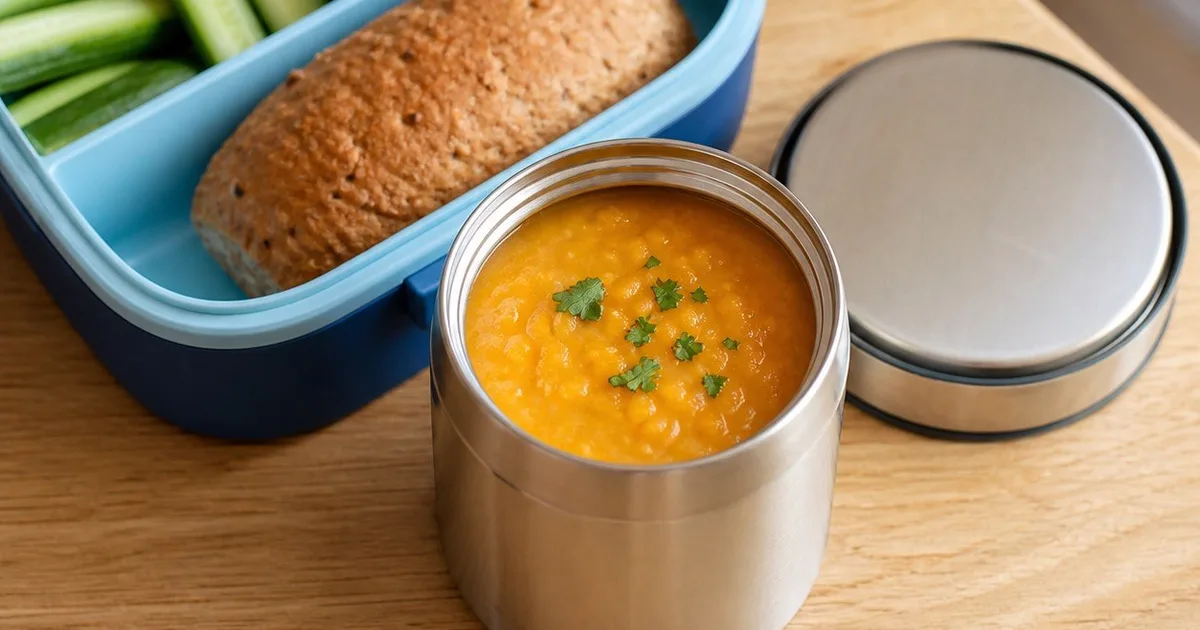
Terms 2 and 3 are the stretch of the New Zealand school year where a cold sandwich stops being appealing and starts being a negotiation. A hot lunch is the obvious answer. Some schools can already provide one — Ka Ora, Ka Ako, the government's Healthy School Lunches Programme, serves hot meals at participating schools, so the first thing worth checking is whether yours is one of them. For everyone else, the delivery problem is blunt: a New Zealand primary classroom has no microwave, no oven a child can reach, and no one to reheat anything at midday. Whatever leaves your kitchen hot has to arrive hot on its own, and the only container that does that is a vacuum flask.
Why a Flask, Specifically
A lunchbox has no heat source. Whatever temperature the food is when the lid closes is the best it will ever be — from there it drifts toward the temperature of the bag, and then of the classroom. Insulation slows the drift. Nothing in a school bag reverses it.
That drift is the whole problem, and New Zealand Food Safety (MPI) names it for this exact case: when school lunches get too warm, the food can become unsafe to eat. Almost all of their packed-lunch advice is about holding the box on the cold side — freeze the drink bottle overnight, pack perishables between chilled items, have children eat the chilled food first. A flask is the other way out of the same problem. Instead of holding the food below the range where bacteria multiply — what our lunchbox food safety guide calls the danger zone — you hold it above.
The failure sits between the two, and it is worth naming plainly. Warm food in an ordinary container is not a halfway compromise — it is the worst of both. It has left the cold side and it cannot hold the hot side, so it spends the whole morning drifting through the middle. A flask filled carelessly is a bigger food-safety problem than a cold sandwich, not a smaller one. That is why the preparation steps further down are not optional polish; they are the entire mechanism.
One thing to settle before buying anything: ask your school what it allows and what it can help with. Schools differ on glass-lined flasks — the same question a glass drink bottle raises — on where lunch is eaten, and on whether a staff member will open a stiff lid for a new entrant. An article cannot answer that for you, and the answer changes what is worth owning.
Which of Our 14 Menus Are Built for a Flask
The planner has a Thermos-friendly only toggle. Turning it on narrows the library to the 14 menus that are meant to be sent hot:
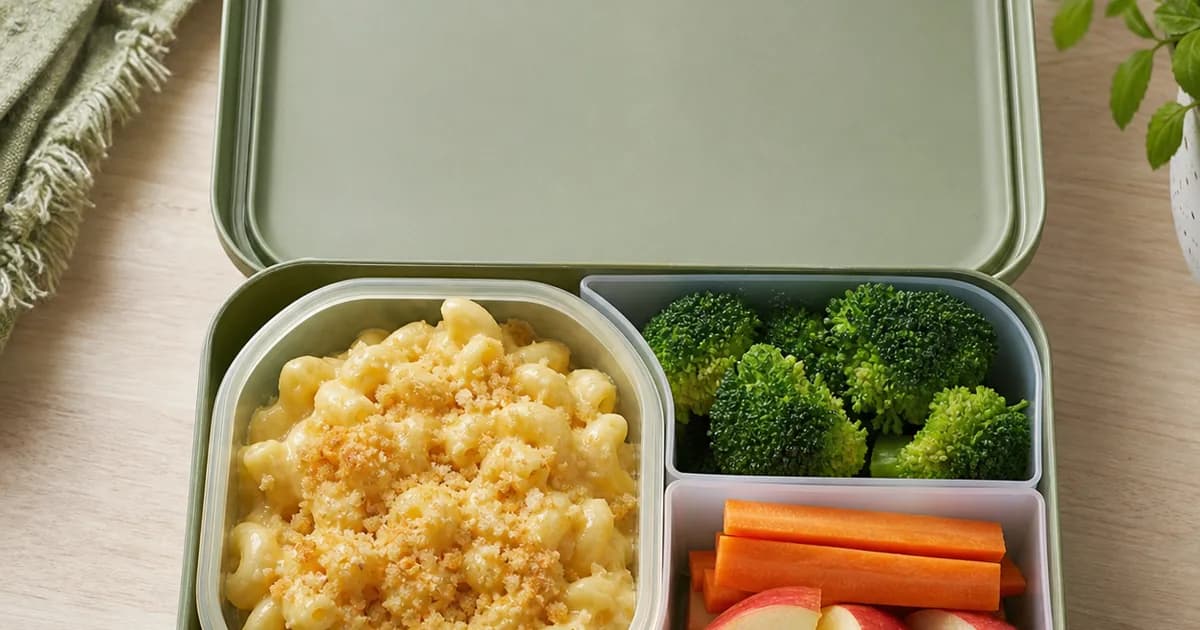
- Mac 'n Cheese
- Fried Rice
- Teriyaki Chicken & Rice
- Mini Meatballs
- Spaghetti Bolognese
- Butter Chicken & Rice
- Vegetable Curry
- GF Pasta with Tomato Sauce
- Tofu Stir-fry
- Lentil Soup
- Chilli con Carne
- Noodle Stir-fry
- Savoury Rice
- Samoan Chop Suey
That list is generated from our menu data rather than typed out, so it stays true as the library changes. A few things fall out of it that shape the week rather than the single lunch:
- All 14 are cook-fresh. Not one is a no-cook assembly job. A flask lunch is a cooked meal by definition, and that — not the container — is the real cost of the format.
- 12 of the 14 are dairy-free and 6 are gluten-free, so the toggle composes with the allergy filters instead of emptying the plan.
- 7 are vegetarian, which is usually the group people expect a hot-lunch list to be short on.
- All 14 are nut-free, so a flask lunch fits a nut-free classroom without further substitution. Our nut-free article covers what those policies usually ask for.
The pattern in the list is not an accident. What survives a flask is wet, dense and already soft: sauced rice, mince in a sauce, a thick soup, pasta cooked past al dente. What does not survive is anything whose appeal is a texture contrast — crisp, crunchy, or crumbed goes in crisp and comes out steamed. That is not a food-safety rule, it is a texture one, and it is the reason a meal that reheats beautifully at home can still come back uneaten.
What the Morning Actually Involves
The flask itself is the easy part. The two steps that decide whether it works are both about temperature, and both happen before the food goes in.
Pre-warm the flask. An empty steel flask sits at room temperature, and a New Zealand kitchen in July — in a house that in most of the country is heated in one room and not the others — is a long way below serving temperature. Fill it with freshly boiled water, put the lid on, and leave it while you finish the meal, then tip the water out immediately before filling. Skip this and the flask takes its warm-up heat out of the food — which is why a hot lunch can arrive lukewarm even when the food went in steaming. Our Term 1 food safety article describes the same step from the opposite season.
Fill it hot, and fill it full. MPI's instruction for reheated food is piping hot — over 75°C — and a flask cannot add heat later, so the food has to go in at that point rather than near it: steaming, straight off the heat, not rested on the bench while you pack the rest. Air is the other cost. A part-filled flask is carrying a pocket of air that has to be warmed too, and the smaller the portion the more that costs you — which is an argument for buying the flask that matches what your child actually eats rather than the largest one on the shelf.
Both steps mean a flask lunch is a cook-fresh morning, and all 14 of our thermos menus carry that tag for exactly that reason. There is one way around it worth planning for: cook the meal the night before as part of dinner, refrigerate it, and reheat a single portion to steaming in the morning. That is a batch-cooking pattern rather than a different recipe, and our batch cooking article covers how to build a week around it.
Note the order there. Reheat, then fill. A flask holds heat; it does not create it, and it cannot lift cold food back up to a safe temperature.
Food Safety for Hot Lunches
The cold-lunch rules most parents know do not transfer to a flask. The short version, drawn from New Zealand Food Safety's packed-lunch advice and from its Food safety at home booklet, which is where the actual numbers live:
- Reheated food goes in piping hot — MPI's line is over 75°C. That is the number the morning routine is built around, and it is the one figure in this article that a thermometer in your own kitchen can check.
- The two-hour clock runs at the cooking end, not just the eating end. MPI's rule for leftovers is to refrigerate or freeze them within two hours of cooking. Last night's dinner earns its place in a flask by having gone into the fridge fast — not by having sat out cooling on the bench.
- A flask is not a way to carry last night's dinner warm. Refrigerate it cold, reheat it to steaming, then fill.
- Wash it properly, seal included. The rubber seal in the lid is the part that gets skipped, and it is the part that stays damp between washes. Removable seals get cleaned; moulded ones get forgotten.
Our lunchbox food safety guide sets out the temperature rules in full, and the Term 1 heat article covers the cold-side version of the same problem.
This article is informational and follows publicly available New Zealand Food Safety guidance. It is not medical or dietary advice. If your child has a medical condition affecting what they can eat, talk to your GP or a registered dietitian.
Choosing a Flask: What to Look At
Mouth width — the one that decides whether it is usable at all. A narrow-mouthed drink flask will take a thin soup and nothing else. No rice, no pasta, no mince, and a child cannot get a spoon into it or clean it out afterwards. A food flask has a mouth wide enough to eat straight out of. The two are easy to confuse, so read the description rather than the silhouette: something labelled a bottle, with a screw cap sized for drinking, is not a food container whatever it is made of.
Vacuum-insulated stainless steel, not merely "insulated". The word insulated appears on foam-walled containers too. What holds heat through a school morning is a double wall with a vacuum between the layers.
A lid the child can open unaided. A seal tight enough to hold heat is tight enough to defeat small hands, and the adult who packed it is not there when the lid has to come off. This is worth testing at the kitchen table before it is tested at school.
Capacity matched to the portion. Bigger is not better here, for the air-pocket reason above.
Serviceability. Lids with removable seals can actually be cleaned. Sealed-in ones cannot.
What a Flask Lunch Costs
The flask itself costs money once. What goes in it is the part that repeats.
14 of our 94 menus are built for a flask, and costed against the prices behind our NZ Lunchbox Price Index a thermos main costs about 11% less than the rest of the menu set — median $2.16 against $2.42 for everything else.
So on our numbers the food in a flask is the cheaper option. A flask suits soup, pasta, rice and stew: dishes built on legumes, grains and small amounts of meat rather than on sliced deli meat and cheese.
What the winter switch does cost is the flask, a cooked (or reheated) meal on a school morning — every one of the 14 is cook-fresh — and the pre-heating the section above describes. It saves no morning effort; it moves the effort to the stove.
What We Have Not Measured
Saying this plainly is more useful than a number we would have to invent:
- Heat retention. We have not put a thermometer in a flask, of any brand, at any price. That is why no hours figure appears anywhere above, and why this article does not rank brands. A duration printed on packaging is a manufacturer's claim, not something we can hand you as our own.
- Prices. We have not price-checked food flasks in a New Zealand store, so this article names no retailer and no range. Our insulated lunch bag review quotes prices because those were read off a shelf and the tickets photographed; we have no equivalent for flasks, and quoting an online listing as though it were a shelf is precisely the mistake that article exists to avoid.
- Whether the food is still appetising at lunchtime, which is a different question from whether it is still safe, and the one that actually decides whether the box comes home empty.
If any of those get measured, this article gets the numbers and the date they were taken. That is how the rest of the site works, and an article about winter lunches is not a good place to start making exceptions.
Plan a Week of Thermos Lunches
The Kiwi Lunchbox Planner has the Thermos-friendly only toggle built in. Tick it — alone, or alongside your allergy filters — and the week's main dishes are drawn only from the 14 menus above, costed on this week's New Zealand supermarket prices. The toggle applies to the main only; snacks still follow any allergy filters you tick.
References
- New Zealand Food Safety (Ministry for Primary Industries): Keeping school lunches safe — mpi.govt.nz/…/keeping-school-lunches-safe — for the packed-lunch advice this article is built on. That page is deliberately qualitative; the temperatures and times below come from the booklet instead.
- New Zealand Food Safety: Food safety at home booklet — mpi.govt.nz/dmsdocument/3662-Food-Safety-in-the-Home — page 5 for the 5°C–60°C danger zone and its four-hour limit, page 10 for the two-hour leftovers rule and the over-75°C reheating line.
- New Zealand Food Safety (Ministry for Primary Industries): Safe food preparation, cooking, and storage at home — mpi.govt.nz/…/safe-food-preparation-cooking-and-storage-at-home — for the over-75°C reheating line and the two-hour rule on leftovers.
- Ministry of Education: Ka Ora, Ka Ako — Healthy School Lunches Programme — education.govt.nz — for whether your school already serves a hot lunch.
Both MPI pages were opened and read on 20 August 2026. MPI's older `/food-safety/food-safety-for-consumers/` address now redirects to a section index that carries no temperature figures of its own, so it is not cited here.
References & Sources
About this article
This article was researched and written by Yong Jae Lee, a parent based in Auckland who runs Kiwi Lunchbox as a solo project. I am not a dietitian or a health professional, so nothing here is medical advice. Where an article rests on desk research rather than something I have cooked or used myself, it says so, and nutrition writing is aligned with New Zealand's healthy eating guidelines. If you spot an error or have a suggestion, please contact us.