Yong Jae Lee
Published: October 12, 2026 · Reviewed: October 2026 · 7 min read
Researched and written by Yong Jae Lee · Content follows NZ Ministry of Health guidelines
What the Ministry of Health's choking guidance for early learning services says to leave out of a kindy lunchbox, and how to cut up the rest.
Why Under-5s Need Different Food
Babies and young children choke on food more easily than older children. The Ministry of Health gives two reasons: their air and food passages are small, and they are still learning to move food around their mouths and to bite, chew and grind it. It takes years to master those skills, and many children don't truly master chewing until about four years of age.
In December 2020 the Ministry published Reducing food-related choking for babies and young children at early learning services. It adapts the Ministry's choking advice for parents to licensed early learning services — early childhood education services, ngā kōhanga reo and certificated playgroups. Staff there can't watch each child as closely as a parent at home, so the guidance is more prescriptive: it names foods to leave out altogether, and says how to change the size, shape or texture of others.
This page puts the food part of that guidance in plain English and shows where it touches the menus and snacks in our planner. It is a summary, not a replacement — the original PDF is short and worth reading in full.
Foods to Leave Out
The guidance says to exclude these foods. They have the highest risk of choking, and are either not practical to alter, have little or no nutritional value, or both. The right-hand column is where each one turns up in our data — these are what the planner's Kindy option removes.
| The guidance says to exclude | Where it appears in our menus and snacks |
|---|---|
| Whole nuts or pieces of nuts | Nothing in our menus or snacks |
| Large seeds, like pumpkin or sunflower seeds | Nothing in our menus or snacks |
| Hard or chewy sweets or lollies | Nothing in our menus or snacks |
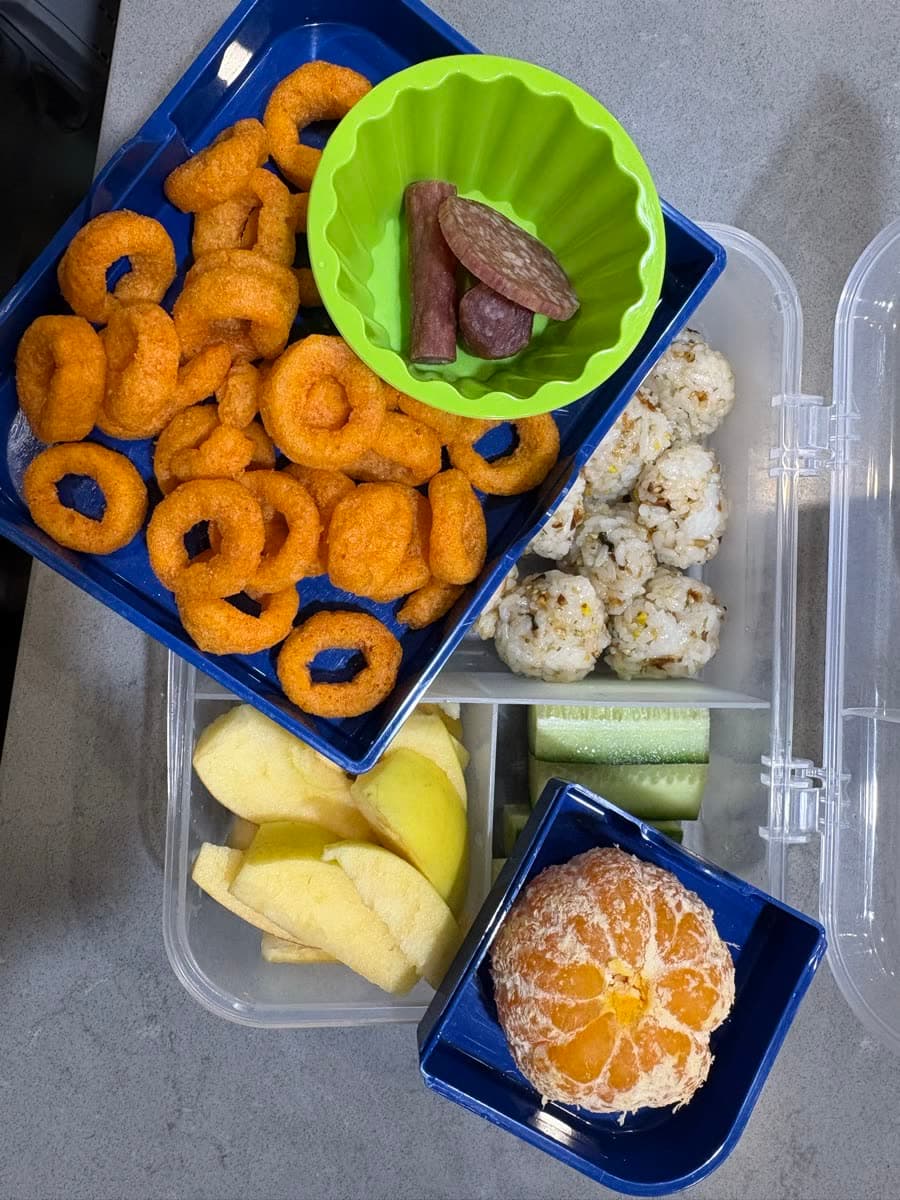
| Crisps or chippies and corn chips | Snacks: Rice Wheels and Veggie Straws; mains: Nachos (corn chips) |
| Hard rice crackers | Snacks: Rice Crackers and Wholegrain Crackers; mains: Veggie Sticks & Hummus Box (gf crackers) |
| Dried fruit | Treats the planner never packs: Bliss Balls (dates), Dried Apricots, Sultanas and Fruit Leather; mains: Yoghurt & Muesli and Date & Oat Slice |
| Sausages, saveloys and cheerios | Mains: Sausage & Mash (GF) and Cocktail Sausages (Cheerios) |
| Popcorn | Snacks: Popcorn |
| Marshmallows | Nothing in our menus or snacks |
One extra that is our call, not the guidance's
The guidance does not mention roasted chickpeas. We leave the Roasted Chickpeas snack out of kindy plans anyway: they are small and hard, like nuts, and there is no practical way to cut them down. That is our own judgement, not something the Ministry of Health says. Cooked chickpeas inside a main are soft, so those mains stay in: Vegetable Curry and Chickpea Salad Sandwich.
Foods to Change Before Serving
For foods it calls high-risk to alter, the guidance gives an option for children of all ages and, for some foods, an extra option for tamariki aged 4–6. These are the ones that appear in our menus and snacks, with the same wording the planner shows on each day:
| Type of food (the guidance's heading) | In our menus and snacks | All ages | Aged 4–6, you can also |
|---|---|---|---|
| Small hard food | Apple, Pear, Carrot, Celery and Sugar Snap Peas | Grate, spiralise or slice thinly with a mandolin or peeler — or cook until soft and cut into strips about 4–6cm long. | Cut it raw into sticks about 4–6cm long that can be picked up with one hand. |
| Small round or oval food | Grapes, Cherry Tomatoes, Blueberries, Strawberries, Berries and Edamame | Quarter, or finely chop to 8mm × 8mm or smaller. | Halve or quarter instead. |
| Small round or oval food — green peas | Peas | Cook, then squash with a fork. | Serve whole cooked peas. |
| Small round or oval food — fruit with large seeds or pips | Watermelon | Remove large seeds or pips. | — |
| Small round or oval food — fruit with stones | Olives | Remove the stone and chop to 8mm × 8mm or smaller. | — |
| Fruit with skin | Tomato | Finely chop to 8mm × 8mm or smaller. | — |
| Food with skin or leaves — leaves | Lettuce, Cos Lettuce, Spinach, Cabbage and Rocket | Finely slice or chop. | — |
| Food with skin or leaves — chicken skin | Chicken, Chicken Breast, Chicken Thigh and Cooked Chicken | Remove the skin. | — |
| Compressible food | Chicken, Chicken Breast, Chicken Thigh, Cooked Chicken, Ham, Beef, Roast Beef, Turkey, Salami, Pork Shoulder, Bacon, Ham/Bacon, Meatballs, Beef Patty, Chicken Skewers, Chicken/Tofu and Tuna/Chicken/Avocado | Cook until very tender, then mince, shred or chop into 8mm × 8mm pieces. | Offer thin strips about 4–6cm long that can be picked up with one hand or a fork. |
| Food with bones | Smoked Salmon | Remove all bones. | — |
| Thick pastes | Peanut Butter | Use sparingly — spread thinly and evenly on bread. | — |
A few measures from the guidance help here:
- 8mm × 8mm is about half the width of a standard dinner fork.
- Strips of about 4–6cm are long enough to be picked up with one hand.
- "Soft" means the food can be squashed easily between your thumb and forefinger, or on the roof of your mouth with your tongue.
- Tinned fruit in natural juice, drained, is acceptable.
The guidance also covers fibrous or stringy food; nothing the planner packs falls under that heading, so it has no row here.
What we don't flag
We only put a note on foods the guidance names. Cucumber, capsicum, cheese and boiled egg get no note from us — not because they are risk-free, but because the guidance doesn't list them and we won't claim a risk it doesn't state. Supervision still matters for every food.
The ages are based on the expected range of development. If a child has a developmental delay, suspected or diagnosed, the guidance asks services to talk through the child's food with their parents or caregivers.
Eating Safely: The Rest of the Guidance
Food is one of three areas in the guidance. The other two are where and how children eat, and first aid:
- Supervise children while they eat, with enough adults at mealtimes.
- Have a set time when children sit down to eat, rather than grazing.
- Keep distractions down, and ask children not to talk with their mouths full.
- Children should sit up straight — no walking, running or playing while eating.
- Put food directly in front of the child, so they don't twist to the side.
- Teachers and kaiako need to know choking first aid and CPR.
The guidance is written for services, but none of that is hard to copy at home.
Using the Planner's Kindy Option
Tick Kindy (under 5) under Allergies / Restrictions before you generate a plan. With it on:
- Excluded foods are left out. That takes 6 of our 94 mains (Yoghurt & Muesli, Veggie Sticks & Hummus Box, Sausage & Mash (GF), Nachos, Cocktail Sausages (Cheerios) and Date & Oat Slice) and 6 of the 33 snacks the planner packs (Rice Crackers, Roasted Chickpeas, Rice Wheels, Popcorn, Veggie Straws and Wholegrain Crackers) out of the running. The planner never packs treats, so bliss balls, dried apricots, sultanas and fruit leather don't come up either way.
- Each day lists prep notes for anything in the "change before serving" table, and the recipe window adds the 4–6 option.
- It combines with the other filters, so a kindy plan can also be nut-free, vegetarian and so on.
- Portions get smaller. Ticking Kindy also sets the planner's Portion size to Kindy (ages 3–4): about ×0.76 of the standard serve, which is sized for primary school children aged 5–12. The ratio is an estimate from average daily energy needs by age in the Nutrient Reference Values for Australia and New Zealand, not a prescription, and single items like one egg don't scale neatly. You can change the setting.
The snack checker shows the same Kindy line for every snack the planner packs. If your kindy has its own food rules, those come first.
Try the Kiwi Lunchbox Planner →
Source and Licence
This page adapts and summarises Reducing food-related choking for babies and young children at early learning services (Ministry of Health, December 2020), used under the Creative Commons Attribution 4.0 International licence. We have reworded it, reorganised it around the menus and snacks in our planner, and added one judgement of our own (roasted chickpeas), which is marked as ours above. The Ministry of Health has not reviewed or endorsed this page or the planner.
References & Sources
About this article
This article was researched and written by Yong Jae Lee, a parent based in Auckland who runs Kiwi Lunchbox as a solo project. I am not a dietitian or a health professional, so nothing here is medical advice. Where an article rests on desk research rather than something I have cooked or used myself, it says so, and nutrition writing is aligned with New Zealand's healthy eating guidelines. If you spot an error or have a suggestion, please contact us.